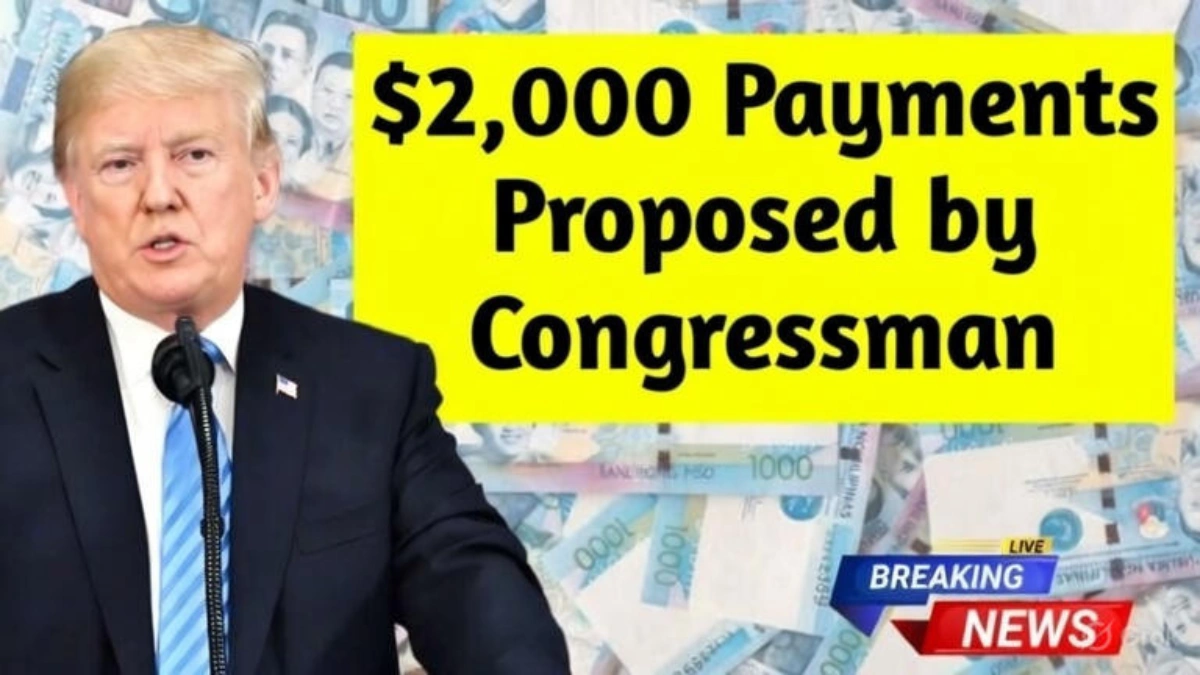
With inflation still squeezing household budgets, news about $2,000 payments proposed by a congressman in 2025 has caught massive attention. Many Americans are asking the same question: is this a real stimulus check for everyone, or just another proposal gaining traction online?
Here is a clear, Google Discover–friendly explanation of what is actually happening, who could qualify if the plan moves forward, and what to realistically expect next.
Where the $2,000 Payment Proposal Comes From
The idea of a $2,000 payment resurfaced after discussions among lawmakers about providing direct financial relief to Americans. Some proposals are linked to the concept of using government revenue, such as tariff collections or budget reallocations, to return money directly to the public.
Unlike pandemic-era stimulus checks, this proposal is not tied to an emergency program. It is being discussed as a policy option to offset rising living costs and economic pressure on middle- and low-income households.

Is There an Approved $2,000 Stimulus Check for 2025
As of now, no $2,000 stimulus check has been approved for 2025. Congress has not passed any law authorizing such payments, and the IRS has not released any official guidance, payment dates, or eligibility rules.
This means there is no guaranteed direct deposit scheduled, and any claims suggesting money is already approved should be treated with caution.
What Lawmakers Are Actually Discussing
Current discussions focus on whether direct payments could be introduced in the future, possibly in 2026 rather than 2025. The proposals are still at an early stage and would require extensive debate, budget approval, and legislative action before becoming reality.
No final amount, structure, or timeline has been agreed upon, and the $2,000 figure remains a suggested amount rather than a confirmed benefit.

Who Could Be Eligible If the Plan Moves Forward
While no eligibility criteria exist yet, past federal relief programs offer clues about how eligibility could work if a payment is approved.
Potential eligibility factors may include:
- Income thresholds with phase-outs for higher earners
- Valid tax filing history with the IRS
- U.S. residency or citizenship requirements
- Possible additional amounts for dependents
These are only possibilities and not official rules.
Why So Many Americans Expect Payments Soon
Confusion is growing because many people receive IRS deposits toward the end of the year that are unrelated to new stimulus programs. These include delayed tax refunds, amended return payments, or refundable tax credits.

When deposits happen to be close to $2,000, they are often mistaken for a new government payment, fueling viral claims and misleading headlines.
What Would Need to Happen Before Any Payment Is Sent
For a $2,000 payment to actually reach Americans, several steps must occur:
- Congress must pass a bill authorizing the payment
- Funding must be formally approved
- The President must sign the bill into law
- The IRS or Treasury must issue official payment guidance
Until these steps are completed, no federal agency can legally issue a stimulus-style payment.
What Americans Should Do Right Now
While waiting for official updates, individuals should:

- Avoid websites claiming you need to apply for stimulus money
- Keep tax filings accurate and up to date
- Ensure IRS direct deposit information is current
- Rely only on official government announcements
Any legitimate federal payment would be automatic and widely announced.
Why This Proposal Matters
Even as a proposal, the discussion highlights ongoing concern about affordability and economic stability. The strong public reaction shows how closely Americans are watching for any form of financial relief and how quickly unconfirmed information can spread.
Understanding the difference between a proposal and an approved program helps prevent false expectations.
Conclusio: The $2,000 payments proposed by a congressman for 2025 are not yet a reality. No stimulus check has been approved, no eligibility rules are finalized, and no payment dates exist. While discussions continue and future relief remains possible, Americans should treat current claims as speculative until Congress and the IRS issue official confirmation.

Disclaimer: This article is for informational purposes only. Government payment programs and eligibility rules may change if new legislation is passed.